

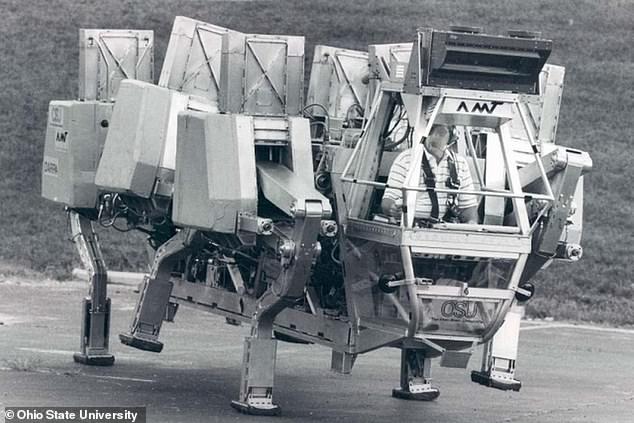
Insect-like walking robots with six legs were developed by US Army for warfare. The machine is powered by a complex system of an engine, flywheel and hydraulics.
An insect-like machine with six individually powered legs that was intended for the battlefield received millions in US government funding during the 1980s. Source: Dailymail.co.uk.
The project to create a fleet of real-life AT-AT walkers from Star Wars started in 1981 at Ohio State University, as the military searched for ways to traverse rough terrain that wheeled vehicles couldn’t manage.
The fate of the Insect-like ASV is a mystery, with nobody knowing whether it is in storage somewhere or was scrapped decades ago.

The project to create a fleet of real life AT-AT walkers from Star Wars started in 1981 at Ohio State University as the US military searched for novel ways to traverse rough terrain
They say: ‘The vehicle uses a legged, rather than a wheeled or tracked, locomotion principle, and is intended to demonstrate the feasibility of systems of this type for transportation in very rough terrain conditions.
‘The vehicle is presently under test, with installation and validation of software modules for different operational conditions scheduled for completion by the end of 1986.’
The innovative machine weighed almost 6,000 pounds and stood 17 feet long, 7.9 feet wide, and 9.8 feet tall.
Its behemoth dimensions allowed it to step over fences and walls while crossing trenches up to 23 feet wide.
However, one of the reasons it failed to live up to expectations and enter into the military’s ground fleet is that it could only do this with a payload of 485 pounds.
Powering the machine was a unique task and everything had to be customised specifically for the ASV.
Engineers came up with an extraordinarily complicated system that would require hydraulic pumps, a 1,000-pound flywheel and a 900cc motorbike engine.
The engine was capable of 91 horsepower but was used to power the flywheel which in turn drove a total of 18 hydraulic cylinders.
This exact process was convoluted and required the engine to power three separate driveshafts. These then transferred power to each leg’s three pumps.
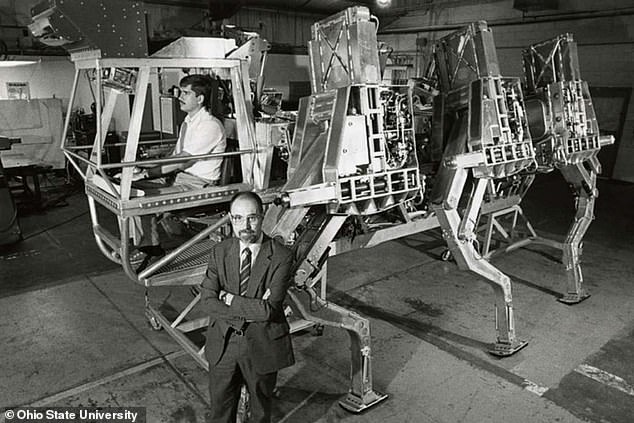
The innovative machine weighed almost 6,000 pounds and stood 17 feet long, 7.9 feet wide, and 9.8 feet tall. It reportedly received $1million a year in funding
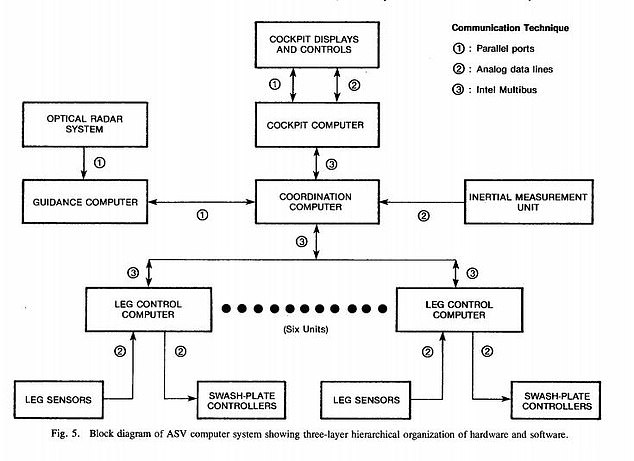
As well as the mechanical components, the ASV also came with 17 individual computers to help the sole driver. Each leg had its own computer, the Intel ’86/30′ 128k, 8-bit chip, which is primitive by today’s standards. The other 11 assisted in the driving, guiding and general operation of the enormous and cumbersome machine (pictured, how computational workload was divided)
With the flywheel spinning at up to 12,000 rpm it could provide 250 watts of power, less than one horsepower, for a total of one hour.
The driver could use more energy, but only for a shorter period of time.
However, for difficult manoeuvers and tricky movements the power needed was greater than could be produced.
As well as the mechanical components, the ASV also came with 17 individual computers to help the sole driver operate the machine.
Each leg had its own computer, the Intel ’86/30′ 128k, 8-bit chip, which is primitive by today’s standards.
The other 11 assisted in the driving, guiding and general operation of the enormous and cumbersome machine.
These help the machine find where to place its legs with the aid of a 128×128-pixel camera as well as controlling and powering the cockpit displays and analysing data.
Developers of the robot had hoped to progress to autonomous navigation, but the project was curtailed before this was possible.
‘The Adaptive Suspension Vehicle is not, in its present configuration, an autonomous robot,’ they researchers wrote in 1986.
‘It carries an operator, who provides supervisory-level commands and, specifically, performs long-range sensing, path selection, and navigation.
‘However, the mechanical and control technologies used are the same as those needed for unmanned operation, and an intensive effort to realise this capability is currently in progress.’

