

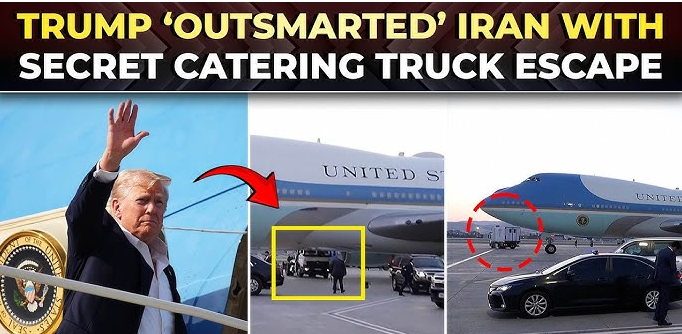
What appeared to be a routine presidential departure from Turkey was, in reality, a carefully orchestrated security operation designed to keep Donald Trump’s whereabouts hidden from a potential attacker.
After the NATO summit in Ankara on July 8, 2026, Trump was expected to leave Turkey aboard Air Force One. Instead, US security officials quietly changed the plan after receiving what sources described as a credible and potentially imminent missile threat.
The extraordinary response involved a catering truck, a second aircraft and a decoy flight.
Trump initially boarded the older Air Force One, maintaining the appearance that he would travel on the aircraft. But shortly afterwards, he was secretly taken off through an airport catering vehicle and moved to a smaller US military aircraft, a C-32A.
The catering truck was used because it offered a discreet way to move the president away from the aircraft without attracting attention on the busy airport tarmac.
Trump was accompanied by a small group of aides, including White House deputy chief of staff Dan Scavino, executive assistant Natalie Harp and Oval Office operations director Walt Nauta, according to reports.
The C-32A then became Trump’s actual escape route from Turkey.
Meanwhile, the original Air Force One departed with White House staff, security personnel and members of the press corps still aboard. The aircraft effectively became a decoy, creating the impression that the president remained on board and making it more difficult for anyone monitoring his movements to determine his true location.
Reporters travelling on the aircraft were reportedly instructed to keep their window shades closed, adding another layer of secrecy to the operation. Some journalists only learned much later that Trump had already left the plane.
The threat behind the dramatic switch was reportedly connected to Iran. At the time, tensions between Washington and Tehran were extremely high, while Trump had previously said he faced threats from Iran.
Reuters reported that US officials received warnings of potential Iranian plots against Trump, although US intelligence agencies were unable to independently verify some of the specific intelligence. Turkish intelligence also reportedly found no evidence supporting the warning connected to the Ankara incident.
Despite the uncertainty surrounding the intelligence, the Secret Service and military chose to act cautiously.
Trump later confirmed that he was moved at the direction of his security team.
“I just follow what they’d like to do, so I go by Secret Service and the military,” he told reporters, adding that he was aware of the threat but did not ask for extensive details.
The president has also pushed back against suggestions that the smaller aircraft necessarily provided him with greater protection. Trump said he believed the plane he ultimately travelled on could actually have been more vulnerable because an attacker might have expected him to be aboard Air Force One.
The revelation has nevertheless triggered a separate controversy: the people who remained on the original aircraft.
More than 100 aides, staff members and journalists reportedly continued travelling on the plane that appeared to be carrying the president. Critics have questioned whether those passengers were unknowingly placed in the position of becoming part of the decoy operation.
The episode has also drawn scrutiny because secret presidential travel is not unusual, but it is normally accompanied by advance coordination with the travelling press corps and selected staff. Reuters noted that previous presidents have made covert trips to war zones, but those involved controlled secrecy arrangements in which accompanying journalists were generally informed and sworn to confidentiality.
This time, the secrecy appears to have been driven by the sudden nature of the threat.
The operation also came amid questions over the security of the newer Boeing 747-8 aircraft donated by Qatar and being prepared for presidential use. Trump had taken the aircraft to Turkey for the NATO summit but unexpectedly chose to leave Ankara aboard an older Air Force One. He later switched back to the newer aircraft in Britain before continuing to the United States.
The unusual episode has since become a source of memes and mockery, particularly in Iranian state media, where images portrayed Trump as hiding inside a catering truck.
But behind the bizarre imagery was a serious security calculation.
US officials apparently believed that keeping Trump’s movements unpredictable was safer than allowing a potential attacker to know which aircraft was carrying him.
The president eventually reached Britain safely before returning to the United States. Yet the revelation has raised a bigger question than the strange sight of a presidential motorcade disappearing beside a catering truck: when a president becomes the target of a credible threat, how much secrecy is justified, and who else should be told when the plan puts them inside the deception?
For Trump’s security team, the immediate mission was clear: get the president out of a potentially dangerous environment without revealing where he was going.
They did it with a decoy plane, a secret aircraft switch and, unexpectedly, a catering truck.

