

Three scientists have won this year’s Nobel Prize in physics for their work in helping to understand black holes, the all-consuming monsters that lurk in the jane molly ashleyalluredarkest parts of the universe.
According to BBC, Roger Penrose, Reinhard Genzel and Andrea Ghez were announced as this year’s winners at a news conference in Stockholm.
The winners will share the prize money of 10 million kronor (£864,200).
David Haviland, chair of the physics prize committee, said this year’s award “celebrates one of the most exotic objects in the Universe”.
Black holes are regions of space where gravity is so strong that not even light can escape from them.
UK-born physicist Sir Roger Penrose, from the University of Oxford, demonstrated that black holes were an inevitable consequence of Albert’s Einstein’s theory of general relativity.
He receives half of this year’s prize, with the other half going to Genzel and Ghez. Prof Ghez is only the fourth woman to win the physics prize, out of more than 200 laureates since 1901.
The other female recipients are Marie Curie, Maria Goeppert-Mayer and Donna Strickland – who won in 2018.

“The history of black holes goes way back in time to the end of the 18th Century. Then, through Einstein’s general relativity, we had the tools to describe these objects for real,” said Ulf Danielsson, a member of the Nobel Committee.
But the mathematics of these objects was incredibly complex. Many researchers believed they were nothing more than mathematical artefacts, existing only on paper. It took researchers decades to realise that they could exist in the real world.
“That’s what Roger Penrose did,” said Danielsson. “He understood the mathematics, he introduced new tools and then could actually prove that this is a process you can naturally expect to happen – that a star collapses and turns into a black hole.”
Sir Roger, he said, “laid the theoretical foundations to say: these objects exist. You can expect to find them if you go out and look for them”.
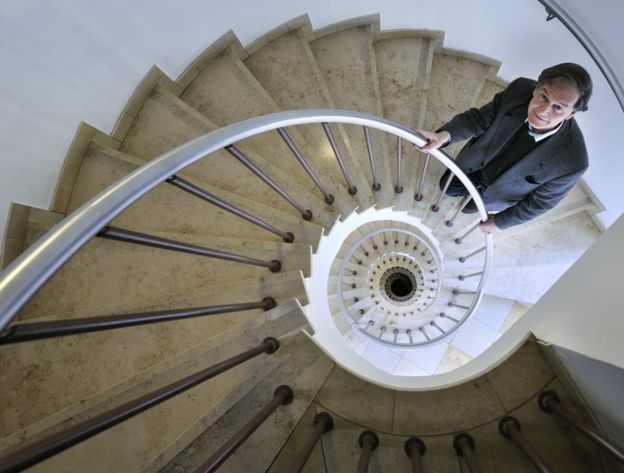 Image copyrightMAX ALEXANDER / SPL
Penrose was born in 1931 in Colchester and comes from a scientific family. He is the son of the psychiatrist and geneticist Lionel Penrose and Margaret Leathes, who was the son of a well-known English physiologist.
In the 1950s, he came up with the Penrose triangle, an impossible object which could be depicted in a perspective drawing but could not exist in reality. The triangle, along with other observations by Sir Roger and his father Lionel, influenced the Dutch artist MC Escher, who incorporated them into his artworks Waterfall and Ascending and Descending.
Inspired by the British scientist Dennis Sciama, Penrose next applied his mathematical ability to physics. In 1965, he published a landmark paper in which he was able to show that a black hole always hides a singularity, a boundary where space and time ends.
The mathematical concept of “trapped surfaces,” was crucial to this giant leap in the characterisation of these exotic objects. A trapped surface forces all rays to point towards a centre, regardless of whether the surface curves outwards or inwards. Once matter begins to collapse, as in the formation of a black hole, and a trapped surface forms, nothing can stop the process from continuing.
Similarly, all matter crosses a black hole’s event horizon in one direction, with everything carried towards an inescapable end at the singularity.
In the 1990s, Reinhard Genzel and Andrea Ghez provided the most convincing evidence yet of a supermassive black hole at the centre of our galaxy – the Milky Way.

What is a black hole?
- A black hole is a region of space where matter has collapsed in on itself
- The gravitational pull is so strong that nothing, not even light, can escape
- Black holes will emerge from the explosive demise of certain large stars
- But some are truly gargantuan and are billions of times the mass of our Sun
- How these monsters – found at galaxy centres – formed is unknown
- Black holes are detected from the way they influence their surroundings
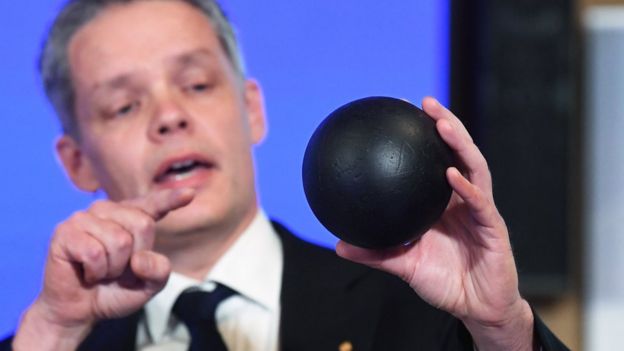 Image copyrightEPA
They found that this huge object, known as Sagittarius A*, was tugging on the jumble of stars orbiting it.
American Prof Ghez, from the University of California, Los Angeles (UCLA), said: “I’m thrilled to receive the prize and I take very seriously the responsibility of being the fourth woman to win the Nobel prize [in physics].”
For more than 50 years, physicists had suspected that there may be a black hole at the centre of the Milky Way. But the technology had to catch up before this idea could be demonstrated.
Prof Genzel, from the Max Planck Institute for Extraterrestrial Physics in Garching, Germany, and Ghez used the world’s largest telescopes to see through huge clouds of interstellar gas to the centre of the Milky Way.
Their discovery stretched the limits of technology; they had to develop new techniques to compensate for distortions to their observations caused by the Earth’s atmosphere.
Swedish industrialist and chemist Alfred Nobel founded the prizes in his will, written in 1895 – a year before his death.
Follow Paul on Twitter.
Previous winners of the Nobel Prize in Physics
 Image copyrightESO / M KORNMESSER
2019 – James Peebles, Michel Mayor and Didier Queloz shared the prize for ground-breaking discoveries about the Universe.
2018 – Donna Strickland, Arthur Ashkin and Gerard Mourou were awarded the prize for their discoveries in the field of laser physics.
2017 – Rainer Weiss, Kip Thorne and Barry Barish earned the award for the detection of gravitational waves.
2016 – David Thouless, Duncan Haldane and Michael Kosterlitz shared the award for their work on rare phases of matter.
2015 – Takaaki Kajita and Arthur McDonald were awarded the prize the discovery that neutrinos switch between different “flavours”.
2014 – Isamu Akasaki, Hiroshi Amano and Shuji Nakamura won the physics Nobel for developing the first blue light-emitting diodes (LEDs).
2013 – Francois Englert and Peter Higgs shared the spoils for formulating the theory of the Higgs boson particle.
2012 – Serge Haroche and David J Wineland were awarded the prize for their work with light and matter.

