

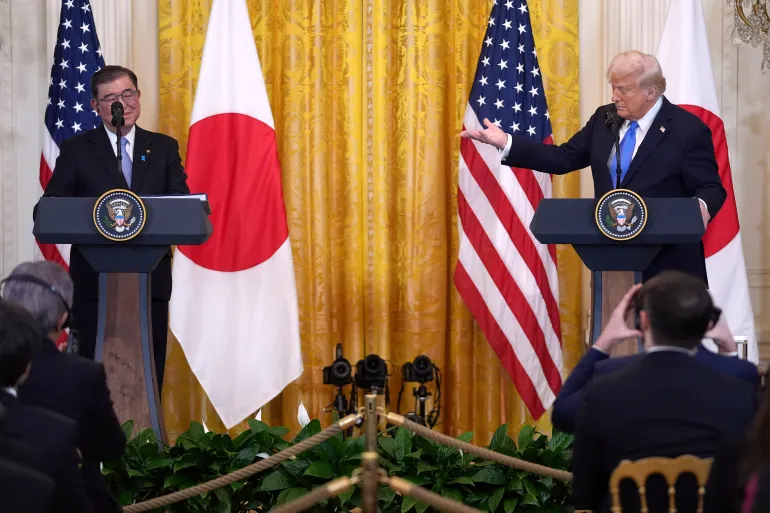
In a surprising diplomatic turn, President Donald Trump announced a landmark trade agreement with Japan on July 22, 2025, during a GOP reception on Capitol Hill. What had seemed out of reach just weeks earlier is now being billed as “perhaps the largest deal in history with Japan.”
“I just signed the largest trade deal in history; I think maybe the largest deal in history with Japan,” Trump proclaimed, describing the pact as “a great deal for everybody.”
Reuters+8Reuters+8The Economic Times+8
Deal Highlights
15% Reciprocal Tariffs Across the Board
Japanese auto tariffs drop from 27.5% to 15%, a politically significant concession ahead of the previously threatened 25% levies. Other goods face the same 15% rate, keeping planned August tariffs at bay. Investing.com+3Reuters+3Reuters+3
$550 Billion Investment Pledge
Under the new “Japan Investment America Initiative,” Japan’s state-backed banks and agencies may deploy up to $550 billion in loans and guarantees to boost U.S. industries—semiconductors, pharmaceuticals, autos, critical minerals—with 90% of profits retained in the U.S. Reuters+5Investing.com+5Reuters+5
Market Reaction & Economic Ripples
Tokyo’s Nikkei jumped ~4%; auto giants like Toyota, Honda, Nissan, and Mazda surged 8–14%. The yen traded choppily, reflecting political unease around PM Ishiba’s position, but markets showed renewed confidence. Trump’s Take & Japan’s Response
Trump took to Truth Social, pledging Japan would “[open] their Country to Trade, including Cars and Trucks, Rice and certain other Agricultural Products,” while calling it a job-booster for the U.S. The Economic Times+6Reuters+6The Guardian+6
Prime Minister Shigeru Ishiba called the tariff cut “the lowest rate ever applied among countries with a trade surplus with the U.S.,” but emphasized that 50% steel and aluminum tariffs remain in place, a win for domestic industry protection. Outside Perspectives & Broader Impacts
Markets globally cheered, with Asian and U.S. equities gaining on hopes of reduced trade friction. U.S. automakers voiced concerns over the competitive edge Japan now gains, especially if Canada and Mexico remain at 25% tariffs. Analysts note this marks a shift from Trump’s earlier “Liberation Day” tariff blitz—moving toward flexible, country-specific deals that diverge from his template. Why It Matters
Biggest bilateral investment package of the Trump era—scaling far beyond previous tariffs. Supports U.S. strategic sectors: semiconductors, autos, energy, critical minerals. Signals a recalibrated U.S. trade playbook—transitioning from sweeping tariffs to bespoke pacts. Raises geopolitical stakes: South Korea is watching closely, demanding parity; Europe and Canada may press for similar terms. Investing.com
Bottom Line
Trump’s $550 billion package with Japan isn’t just a pause on tariffs—it’s a strategic gamble that intertwines investment, diplomacy, and domestic politics. If executed well, it could reset the U.S.-Japan economic axis and set a precedent for future agreements. But looming questions remain: Will Japanese profits benefit U.S. workers? ms missbalixo Will other countries demand equal footing? And will American industries weather the competitive pressure? One thing’s clear: Trump’s trade playbook just flipped pages—and the world is watching how the next chapter unfolds.

