

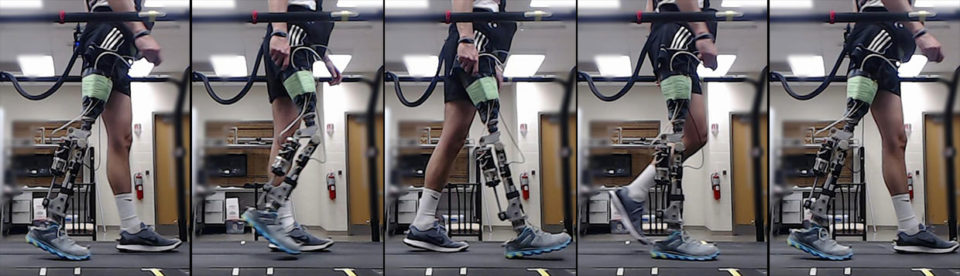
The International Space Station (ISS) has developed a flexible robotic leg that can perform and even react like a human joint would.
The institution of engineering and technology, on the 16th of July, 2020 published the novel research project through the ISS. The article is titled; space tech used to build improved prosthetic leg, and the article was published by Toby Elery and his team members.
The streamlined design offers a free-swinging knee and regenerative braking, which gradually charges the battery with energy captured when the foot hits the ground. This feature enables the leg to more than double a typical prosthetic user’s walking distance with one charge per day.
“Our prosthetic leg consumes approximately half the battery power of state-of-art robotic legs, yet can produce more force,” said Professor Robert Gregg, an engineer at the University of Michigan.
“We designed our joints to be as compliant, or flexible, as possible,” said Toby Elery, first author of the study. “Our robotic leg can perform and even react like a human joint would, enabling a naturally free-swinging knee and shock absorption when contacting the ground.”
Motors in robotic legs need to fit into the space that an ordinary limb would take up. In the past, this has meant using small motors which spin quickly, and then using a series of gears to amplify their force.
The problem is that the gears are noisy, inefficient, add weight and make it harder for the joints to swing. The motors designed for the ISS can resolve this problem, with one powering the knee and the other powering the ankle.
In addition to enabling the free-swinging knee, removing gears brought the noise level down from the scale of a vacuum cleaner to that of a refrigerator. Also, the regenerative braking absorbs some of the shock when the prosthetic foot hits the ground.
“If the joints are stiff or rigid, the force is transferred to the residual limb, and that can be painful,” Gregg said. “Instead, we use that force to charge the battery.”
Participants testing the prosthetics in Gregg’s lab said they can feel the leg helping them push off the ground as they walk.
“In some cases, they have observed that they feel like muscles in their hips and back are working less with our leg, compared to their conventional leg,” Gregg said. “We’re able to reduce compensations at the hips.”
The team’s next step is to improve the control algorithms that can help the leg automatically adjust to different terrain, changes in pace and transitions between different types of activity.

