

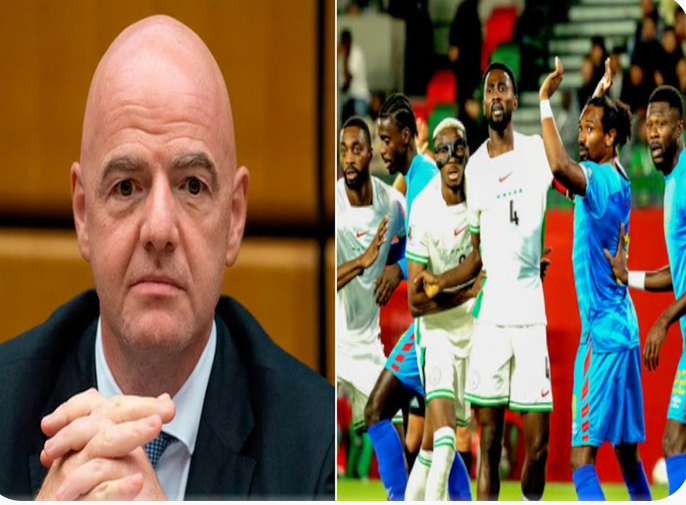
Nigeria’s bitter absence from the 2026 FIFA World Cup has taken another dramatic turn following revelations that FIFA officials were allegedly aware of an unresolved eligibility issue involving Democratic Republic of Congo goalkeeper Lionel Mpasi.
The new details, reportedly contained in internal FIFA documents reviewed by The New York Times and Le Monde, have revived questions about how Nigeria’s eligibility complaint was handled and whether FIFA could have taken a different course before DR Congo secured its place at the World Cup.
The controversy stems from the African play-off final played in Rabat, Morocco, on November 16, 2025.
Nigeria and DR Congo battled to a 1-1 draw after extra time before the Leopards won 4-3 on penalties, ending the Super Eagles’ hopes of reaching the tournament.
Mpasi was in goal for DR Congo throughout the 120-minute encounter.
Nigeria subsequently challenged the eligibility of several DR Congo players, raising concerns about their nationality and international status. The Nigerian Football Federation (NFF) took the matter to FIFA, but the governing body’s Disciplinary Committee rejected the protest.
The NFF later announced that it would appeal the decision.
FIFA Lawyers Raise Mpasi Concern
The latest revelations have shifted attention to Mpasi, who was born in France and represented the country at youth level, including at the 2011 FIFA Under-17 World Cup.
According to documents cited by Le Monde, FIFA’s legal department discovered in March 2026 that Mpasi had apparently not completed the formal process required to switch his international allegiance from France to DR Congo.
The issue was significant because Mpasi had already represented DR Congo in several World Cup qualifying matches, including the crucial play-off victory over Nigeria.
FIFA’s lawyers reportedly examined the potential consequences and concluded that sanctions could have triggered a major change in the African qualification pathway.
One possible scenario was that DR Congo’s results in affected matches could have been overturned, potentially opening the door for Burkina Faso to advance instead.
The legal assessment reportedly considered several options, including disciplinary proceedings against Mpasi and the Congolese football federation, sanctions against DR Congo and, under certain circumstances, Nigeria replacing DR Congo in the intercontinental play-off against Jamaica.
None of those measures was ultimately imposed.
Why Was DR Congo Allowed to Continue?
Instead, FIFA maintained that Nigeria’s complaint was inadmissible on procedural grounds.
The governing body said its decision had been communicated to the NFF and subsequently became final after the appropriate appeal process was not completed.
FIFA has also maintained that its judicial bodies operate independently and make decisions according to the relevant regulations and evidence presented before them.
The revelations have nevertheless raised questions because FIFA’s own legal officials were reportedly examining Mpasi’s eligibility after the Nigerian complaint had already been rejected.
That has turned the controversy from a straightforward eligibility dispute into a broader debate about how consistently FIFA applies its rules.
Infantino Connection Raises More Questions
The issue has also drawn attention to FIFA president Gianni Infantino’s relationship with Véron Mosengo-Omba, who became president of DR Congo’s football federation in May 2026.
The pair have known each other for years, having studied together and later worked within European and international football administration.
That relationship has fuelled speculation about possible conflicts of interest, although there is currently no established evidence that Infantino personally intervened to influence the outcome of the eligibility case.
FIFA has rejected suggestions of political interference and insisted that the process was handled through its established judicial structures.
What It Means for Nigeria
The stakes could hardly be higher for Nigeria.
The Super Eagles’ defeat to DR Congo effectively ended their qualification campaign, while the Leopards went on to beat Jamaica 1-0 in the intercontinental play-off and secure their place at the 2026 World Cup.
DR Congo subsequently progressed to the knockout stage of the tournament before suffering a 2-1 defeat to England. Mpasi was part of the squad during the World Cup campaign.
For Nigerian football supporters, the new revelations have therefore reopened an old wound.
The issue is no longer simply about a penalty shoot-out defeat. It is about whether Nigeria’s final route to the World Cup was affected by a player whose international eligibility was allegedly being questioned within FIFA itself.
The NFF’s original protest may have been rejected, but the newly reported documents have created fresh demands for transparency over what FIFA knew, when it knew it and why no sporting sanction followed.
At the centre of the controversy is a question that Nigerian football authorities and supporters are likely to keep asking:
If FIFA’s own legal officials identified a potential eligibility problem involving a player who featured in DR Congo’s World Cup qualifying campaign, why was the result not revisited before Nigeria’s World Cup hopes were permanently extinguished?

